Luke Rosedahl
PhD Student in Dynamical Neuroscience
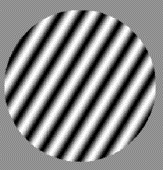
It was A!
Why? Because the stripes were a certain thickness and angle.
What could we learn from that? Read below!
PhD Student in Dynamical Neuroscience
It was A!
Why? Because the stripes were a certain thickness and angle.
What could we learn from that? Read below!
The disc you just made a category judgment for is called a Gabor Disk and is used to study human learning. Now, you might be thinking: but I don't see discs like that in real life, and you would be right. In normal life, we don't often have to categorize gabor disks. So why use them? For that very reason: because we don't see them often, we have no pre-existing notions of categories for them. So any behavior we see in the lab is likely due to the experiment; similar to how you randomly guessed which category the disk on this page belonged to, subjects in the lab start off randomly guessing.
So why were you correct if you said the disk was category A? What made it an A disk? The answer to that depends on how the experimenter set up the categories, but the short answer is that the thickness of the black and white stripes and the angle of the stripes determines what category it belongs to.
Keep reading to learn more about the different kinds of category structures or click here to return to my home page!
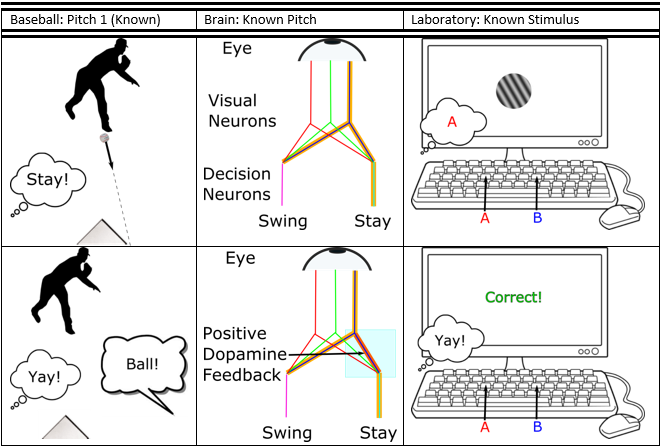
The pitcher throws a pitch that is not headed over the plate. Visual neuron 3 (Blue, on the right) responds to that particular trajectory of the ball and excites the 'Stay' decision neuron, so you don't swing. That was the correct decision, so the umpire calls the ball out (positive reward) and there is dopamine reinforced feedback for the Blue-Stay neuron pathway, making it stronger.
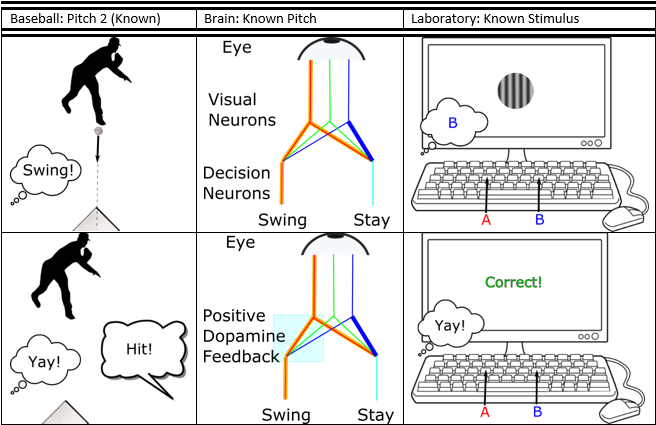
The pitcher throws a pitch that is headed over the plate. Visual neuron 1 (Red, on the left) responds to that particular trajectory of the ball and excites the 'Swing' decision neuron, so you swing and hit the ball! That was the correct decision, so there is dopamine reinforced feedback for the Red-Swing neuron pathway, making it stronger.
The pitcher throws a knuckleball (the first you have ever seen). Visual neuron 2 (Green, middle) responds, but the system doesn't know what that means and it excites both Swing and Stay neurons. The decision is randomly selected as Stay, which is incorrect and results in a strike (negative reward). As the reward is negative, there is negative dopamine feedback for the Green-Stay pathway, making it weaker.
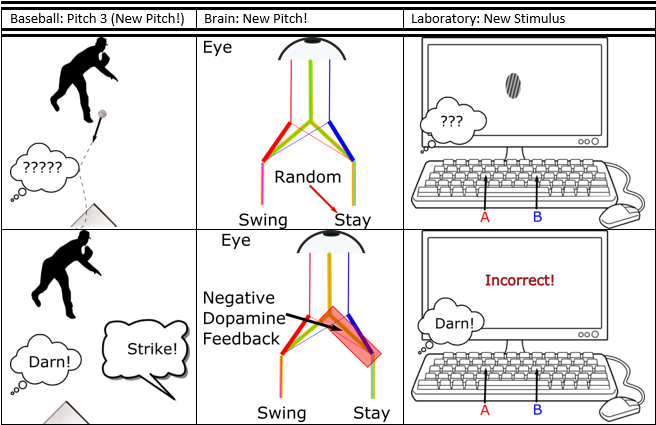
The pitcher watches you make the incorrect decision and decides to throw another knuckleball. This time, because the feedback weakened the Green-Stay pathway, the Green neuron excites the Swing neuron, so you swing and hit the ball (positive reward). As the reward was positive, there is positive dopamine feedback for the Green-Swing pathway, making it stronger.

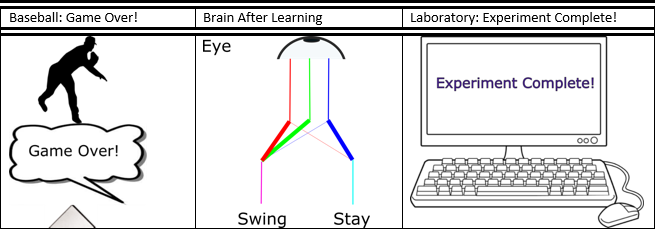
The game is over and you won! Over the course of the game, the Red-Swing, Blue-Stay, and Green-Swing pathways were strengthened, so you learned when to swing, when to stay, and what to do for a knuckleball!